A picture, a person, a time and a location
Thomas Bjelkeman · @bjelkeman
Ur SSWC-boken 2010, s. 77–79 · Läs boken som PDF
I have been going around for a number of months now telling the following story and then asking a question.
Imagine that you had an application on your camera phone which would only take a photograph when it had a good GPS fix, i.e. the application knows where in the world the phone is by getting data from the satellites in the Global Positioning System. Imagine that you took a sequence of photographs, the first picture is of yourself. Each photograph gets the current time as told by the satellites, the GPS coordinates, the phone number, the phone identity and potentially a text message added to it. The whole bundle is digitally signed and uploaded to a server on the internet. The signed bundle is verified by the server to ensure that the bundle has not been manipulated. We now have a set of pictures of something, taken by a person we can identify, at a particular time and a particular location.
The question I ask is:
How would you use this type of system?
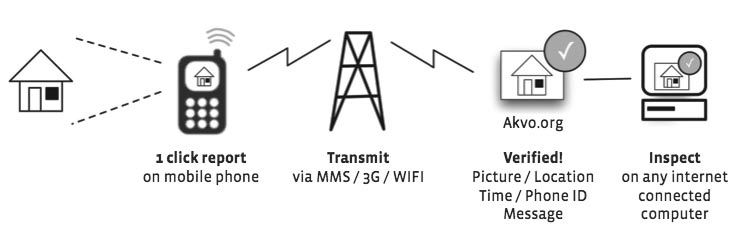
I get many interesting answers. The first answer was from myself. I want to improve the way field reporting is done on development aid projects. The pictures could be of a new well being drilled, the foundations of a school being laid or a meeting being held. This is all part of the work we are doing at Akvo.org, giving every development aid project a voice. A voice which tells the story of what is going on with the project. There are many benefits from using a system like this, as opposed to the traditional 6-12 monthly reporting via thick Word documents.
Other really interesting answers have been:
An NGO that works with war crimes investigations would like to show a picture of something in a particular location, for example signs of a mass grave, at a particular time. It is good that they would only need a mobile phone to do the work as it is fairly sensitive work. If would be beneficial if the proof would be valid as evidence in court.
Someone working with elections in an African country told me he wanted to take pictures of the tally sheets that are sent with the ballot boxes to be centrally counted. So that one could provide independent verification of the counting.
A professor working with e-learning in developing countries would like an examination assistant to be able to take a picture of the students taking an exam, so that it could be verified that the right person is actually doing the exam.
A woman working with human rights issues wanted to be able to use the pictures to document an ongoing riot or crackdown by the government. Think the Iran election demonstrations in 2010, but with verified photographs.
A young man working with legal aid support and training, in countries where the legal system is pretty sketchy, wanted to be able to take a picture of anyone interned or arrested. The pictures would be able to prove that the person was actually held by the police at a particular time and location. People disappear.
I have had several proposed commercial uses of such as system as well, by both big and small companies.
We have a prototype of this system called Akvo Phone, running on a GPS equipped camera phone, integrated with the Akvo Really Simple Reporting (Akvo RSR) system.
Tell me: How would you use this type of system?
THOMAS BJELKEMAN — DÅ
Texten finns publicerad på: http://www.appropedia.org/TheFWD_Bjelkeman_-_A_picture,_a_person,_a_time_and_a_location http://korta.nu/sswc10_17
Thomas is a co-foundner of the Akvo Foundation where he builds online tools to fix povery. Twitter: @bjelkeman | Mail: thomas@bjelkeman.com | Web: bjelkeman.com
THOMAS BJELKEMAN — IDAG
Efterforskat juli 2026 · AI-underlag med källänkar
Projektledare, Försvarsmakten (sedan augusti 2025); även grundare av Metal Sweden Productions (sedan februari 2025) och medgrundare/vd för Johannas Stadsodlingar AB (Stremtech), ett bolag inom cirkulär och hållbar stadsnära livsmedelsproduktion
Bjelkeman-Pettersson var 2006 med och grundade Akvo Foundation, en öppen källkodsbaserad dataplattform som använts av FN, Världsbanken och nationella regeringar för att följa upp tillgången till dricksvatten för över 100 miljoner människor; han var meddirektör och CTO till 2019 och kvarstod som senior rådgivare och ambassadör till 2021. Han var därefter med och grundade Johannas Stadsodlingar, pionjärer inom cirkulär stadsodling med fisk och växter, som fick ett större Vinnova-anslag 2023.
Brev från 2026
En AI har läst texten från 2010 och föreställer sig – varsamt och med glimten i ögat – hur Thomas Bjelkeman kanske skulle svara idag. Det här är INTE Thomas Bjelkemans egna ord.
I am still asking the question, but the world changed it on me. In 2010 I wanted to prove that a true photograph was true — this well, this village, this Tuesday. The signatures, the satellites, the sealed bundle: all of it was about adding trust to images that deserved it. What none of us fully saw was that the harder problem would arrive from the opposite direction. Today the flood is synthetic; machines can paint photographs of things that never happened, and the industry has spent years building provenance standards that look uncannily like the prototype we carried around on a GPS phone. The idea did not just age well. It is becoming infrastructure, one signed pixel at a time.
What I miss from the 2010 version is the guest list. A war-crimes investigator, an election observer, a professor, a young man counting the disappeared — every answer to my question came from someone trying to protect a fact on behalf of someone powerless. That is still the right test for any technology: not what it can verify, but who it defends. I have kept building things since, and I have kept the question. How would you use it?
Är det din text? Skriv ditt riktiga svar – mejla joakim@jardenberg.com – så ersätter vi AI:ns brev med ditt.
Drömmarna i den här texten
Signerade, GPS-verifierade foton som bevis
Slog inC2PA och Content Credentials är idag exakt detta: kryptografiskt signerad proveniens för bilder, inbyggd i kameror från bland andra Leica och i Adobes verktyg. Sexton år före sin tid.
Källor: c2pa.org · contentcredentials.org
AI-underlag med källänkar, utkast juli 2026. Se hela scoreboarden på /drommarna.